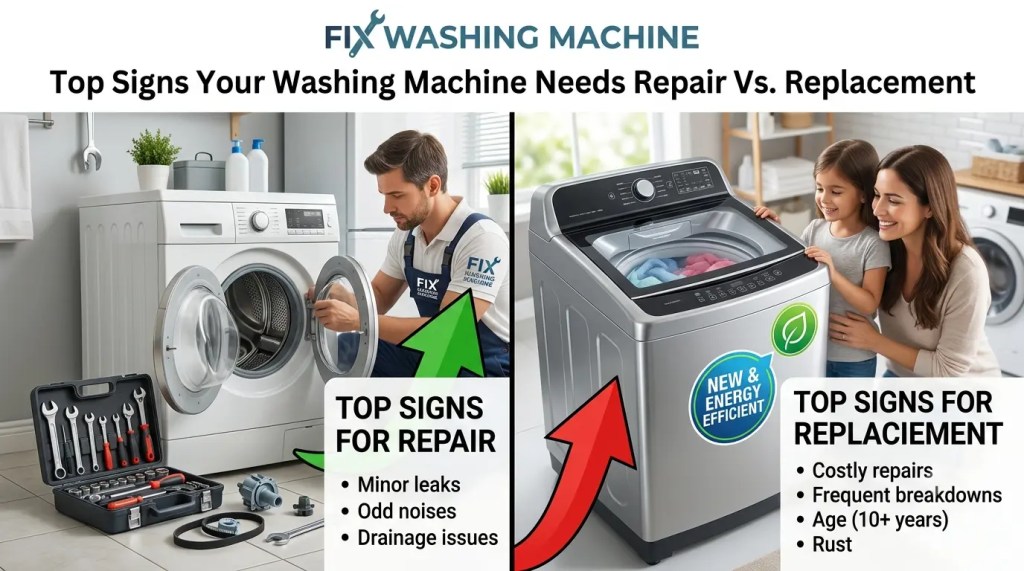
If your washing machine has started acting up, the question on every homeowner’s mind is the same: is this worth fixing, or should I just buy a new one? The answer usually comes down to a handful of clear signs: age, repair cost, frequency of breakdowns, and how the machine is actually performing day to day. Here’s how to read those signs so you can make the call with confidence instead of guessing.
Start With the Age of the Machine
Most washing machines are built to last somewhere between 10 and 14 years with reasonable care. If yours is still within that window and otherwise reliable, a repair almost always makes sense, especially for a first-time issue. Once a machine crosses the 10-year mark, though, the math starts shifting. Parts become harder to source, older models are less efficient than what’s currently on the market, and the odds of another failure showing up soon after this one climb noticeably.
Age alone shouldn’t decide everything, but it’s the first filter worth applying before you spend money on any repair.
Apply the 50% Rule
HVAC and appliance technicians often lean on a simple guideline: if the repair cost is 50% or more of the price of a new machine, replacement is usually the smarter move. Say a comparable new washer runs $700 and your technician quotes $380 for the fix. At that point, you’re better off putting that money toward a machine that’s going to last another decade rather than patching one that’s already partway through its lifespan.
This rule isn’t perfect for every situation, but it gives you a fast, objective way to check a repair quote against reality instead of deciding on gut feeling alone.
How Often Is It Breaking Down?
A single repair after several trouble-free years is normal wear and tear, nothing more. A pattern of repeated service calls is a different story entirely. When a machine needs attention every few months, or a different part fails shortly after the last one was fixed, that’s usually a sign the whole system is aging out together rather than one isolated component failing on its own.
Keep a rough mental note, or better yet a written one, of repairs over the past two years. If the list is getting longer and the bills are climbing, you’re likely feeding money into a machine that’s on its way out regardless of what gets fixed next.
Watch Your Water and Energy Bills
A washing machine losing efficiency often shows up on your utility bill before it shows up as an obvious malfunction. Worn seals, a struggling motor, or a heating element caked in mineral buildup all force the machine to work harder to do the same job, and that extra effort costs you money every single cycle.
If your bills have crept up without any change in your laundry habits, it’s worth having the machine inspected. In many cases, a newer, more efficient model pays back part of its purchase price through lower monthly costs alone.
Pay Attention to Performance, Not Just Breakdowns
Sometimes a machine technically still runs but clearly isn’t performing the way it used to. Watch for:
- Clothes coming out still soaking wet after the spin cycle
- Longer wash times than the machine used to take
- Persistent musty odors even after cleaning the drum
- Loud grinding, banging, or squealing during cycles
- Water leaking from the door seal, hoses, or base of the unit
- Visible rust on the drum or cabinet
None of these alone is necessarily a death sentence, but a machine showing several of them at once is usually telling you it’s nearing the end of its useful life, repair or not.
Consider the Refrigerant and Parts Availability Angle for Older Models
While this applies more directly to certain appliance types, older washing machines can run into a similar issue with parts availability. Manufacturers eventually stop producing components for discontinued models, and once that happens, even a technician willing to do the repair may not be able to source what’s needed. If a repair shop tells you a part is backordered indefinitely or no longer manufactured, that’s effectively a forced answer toward replacement.
When Repair Is Clearly the Right Call
Repair typically makes sense when:
- The machine is under 8-10 years old
- The issue is a single, well-defined problem like a belt, hose, or filter
- The repair estimate is well under half the cost of a new unit
- This is the first significant repair the machine has needed
- Utility bills have stayed consistent
When Replacement Is Clearly the Better Investment
Replacement becomes the more sensible choice when:
- The machine is past the 10-12 year mark
- Repairs are frequent, or the same problem keeps recurring
- The repair quote approaches or exceeds half the price of a new machine
- Parts are difficult or impossible to source
- Performance has noticeably declined even outside of full breakdowns
Final Thoughts
There’s rarely a single sign that makes the repair-or-replace decision obvious on its own. It’s the combination of age, repair cost relative to a new unit, how often problems keep coming back, and how the machine is actually performing that gives you the clearest picture. When a handful of these point in the same direction, that’s your answer.
At Fix Washing Machine, we always recommend getting an honest assessment from a qualified technician before committing either way. A proper inspection takes the guesswork out of the decision and helps you avoid throwing good money after a machine that’s already told you, in more ways than one, that it’s time to move on.

